
By Maria A. Petrova, PhD
Professor of Sustainable Development at the American University in Bulgaria and co-founder of PLΔNET
This summer showed us once again that climate change is not a future business risk anymore. It is happening now, and it is already affecting businesses and cities. In just the past few weeks, Europe has seen record heat, wildfires, droughts, and flash floods. On July 22, a heavy downpour turned the streets of Varna into rivers, flooding ground floors and shops and putting the city’s infrastructure to the test (Radio Bulgaria). France had its hottest July since 1900 (Santé publique France), Brussels broke a daily temperature record set five decades earlier (The Brussels Times), and Slovakia hit an unprecedented 41°C (NetZero Investor).
These events make one thing clear: physical climate risk is no longer an abstract threat. It is becoming a real economic factor that affects building values, investment decisions, and business competitiveness.
A building is not just a place to work, produce, or sell anymore. It is a strategic asset. It has to perform reliably in extreme weather, cut its carbon footprint, use resources efficiently, and meet the growing expectations of investors, customers, and regulators. That is why resilience and climate adaptation now matter just as much as energy efficiency.
The market is already feeling it. Today, buyers and investors look not only at location and build quality, but also at how well a building can handle the climate.
A few examples show how this is playing out:
- Stranded asset risk: Poorly insulated buildings without modern cooling systems lose 20% to 40% of their market value because cooling costs during summer heatwaves become unmanageable (Institutional Asset Manager).
- Urban heat island effect: Commercial and office buildings in dense city centers may generate lower returns when they lack green roofs and shading to offset extreme temperatures (Responsible Alpha).
- Insurance risk: In many parts of Europe, insurers are sharply raising premiums or refusing coverage altogether in high-risk areas. Without insurance, a property cannot get bank financing, and its liquidity drops to zero (E&E News by POLITICO).
After Certificates Come Measurable Results
For years, the construction sector relied on green building certification systems as the main measure of sustainability. These systems have clearly changed the industry. They pushed for better energy efficiency, more sustainable materials, smarter water management, and healthier indoor environments.
Green certificates laid the foundation for sustainable construction. They show that a project follows good practices in design and construction. But today, businesses need more. They need to know what real impact those choices have once the building is in use, and what value they create for investors, occupants, and the city around them.
More and more, the question is not whether a building has a certificate, but what measurable results it delivers. How much have carbon emissions gone down? How does green infrastructure improve the microclimate? What is the contribution to biodiversity? How does quality of life change for the people inside? And most importantly: what value do these solutions create for the business?
This marks the shift from green certification to smart sustainability management, built on real data and measurable outcomes.
European regulation is speeding this up. The revised Energy Performance of Buildings Directive (EPBD), the Corporate Sustainability Reporting Directive (CSRD), and the EU Taxonomy are raising the bar for how companies measure, manage, and prove their environmental impact. Sustainability is not just about compliance anymore. It is becoming a factor in access to finance, risk management, and long-term competitiveness.
From Certification to Nature Performance
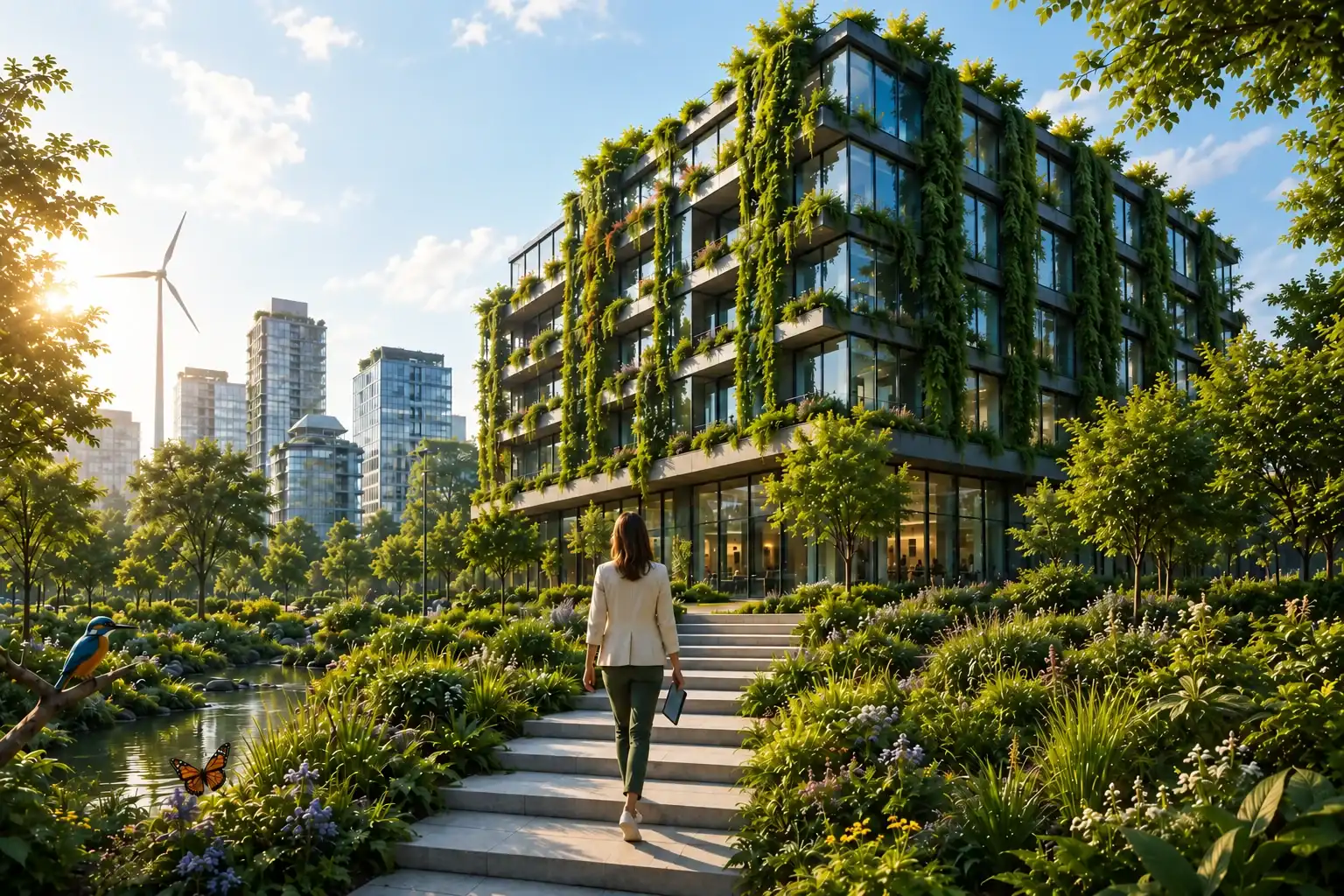
Moving to smart sustainability management calls for a new generation of tools. This is where the idea of Nature Performance comes in: measuring how nature-based solutions actually improve the way buildings perform.
PLΔNET is a science-based AI platform for Nature Performance in Green Construction. It measures how nature improves the built environment and turns that impact into clear, useful information for investors, developers, architects, ESG teams, certification consultants, and public institutions.
Unlike traditional tools, which mostly measure carbon footprint or support certification, PLΔNET looks at the full impact of nature-based solutions on buildings and the urban environment. The platform analyzes how green infrastructure affects carbon balance, cooling of buildings and cities, biodiversity, stormwater management, human well-being, and ecosystem value.
With its AI calculator, PLΔNET lets teams compare different design scenarios at the design stage and put numbers on the benefits of each option. This way, sustainability stops being an abstract idea or a marketing message. It becomes a measurable factor in investment decisions, ESG communication, certification, and conversations with investors, clients, and other stakeholders.
This is the next step for sustainable construction. The first generation of tools answered the question “Does the project meet certain requirements?” The new generation has to answer a much more important one: “What measurable value does nature create for this building, the people in it, and the business?”
Until recently, we measured whether a building was “green.” Now we need to measure what nature does for the building: how it cuts carbon emissions, improves the microclimate, supports biodiversity, makes the building more resilient to climate risks, and creates a better environment for people.
The next decade will not belong to the buildings with the most certificates. It will belong to the buildings that can prove, with data, how nature improves their performance, resilience, and value. That is what Nature Performance is all about, and it is the next step in ESG for buildings.